Not every data consultant starts in a spreadsheet. Some start in a field, pushing gas-sampling chambers into the ground at dawn, or in a molecular biology lab, running gel electrophoresis late into the evening. This is the story of how a career in research science became the foundation for a new chapter in data.
A Decade in Soil Microbiology
My scientific career began in earnest with a MSc thesis on Multiplex Terminal RFLP (M-TRFLP) — a molecular fingerprinting method for characterising soil microbial communities with high resolution. That early work, co-authored with Brajesh K. Singh and published in Applied and Environmental Microbiology, laid the methodological groundwork for years of subsequent research.
Brajesh Singh became my PhD supervisor at the Hawkesbury Institute for the Environment (Western Sydney University), where I completed my doctoral thesis in 2011: Land-use Changes and Methanotrophic Community Structure and Function. The central question was how converting grassland to forest — afforestation — alters the communities of bacteria responsible for consuming methane, one of the most potent greenhouse gases in the atmosphere.
That question turned out to be surprisingly rich. It pulled together molecular ecology, gas flux measurements, statistical modelling, and field work across New Zealand and Australia. It also produced a body of peer-reviewed work that would extend well beyond the thesis itself.
Research Themes
Methane-Oxidising Bacteria and Land-use Change
Methanotrophs — bacteria that consume atmospheric methane — are a small but ecologically significant group. Understanding what controls their abundance and diversity is directly relevant to global greenhouse gas (GHG) budgets. Between 2010 and 2018, my collaborators and I published a series of studies tracing how these communities respond to afforestation in New Zealand, to soil warming, and to shifts in rainfall regimes.
Key publications include:
- Nazaries et al. (2011) — Methanotrophic communities under afforestation
- Nazaries et al. (2013a) — Microbial regulation of biogeochemical cycles and methane flux
- Nazaries et al. (2013b) — A review: methane microbes and Earth system models
- Nazaries et al. (2015) — Microbial community shifts and soil respiration under land-use change
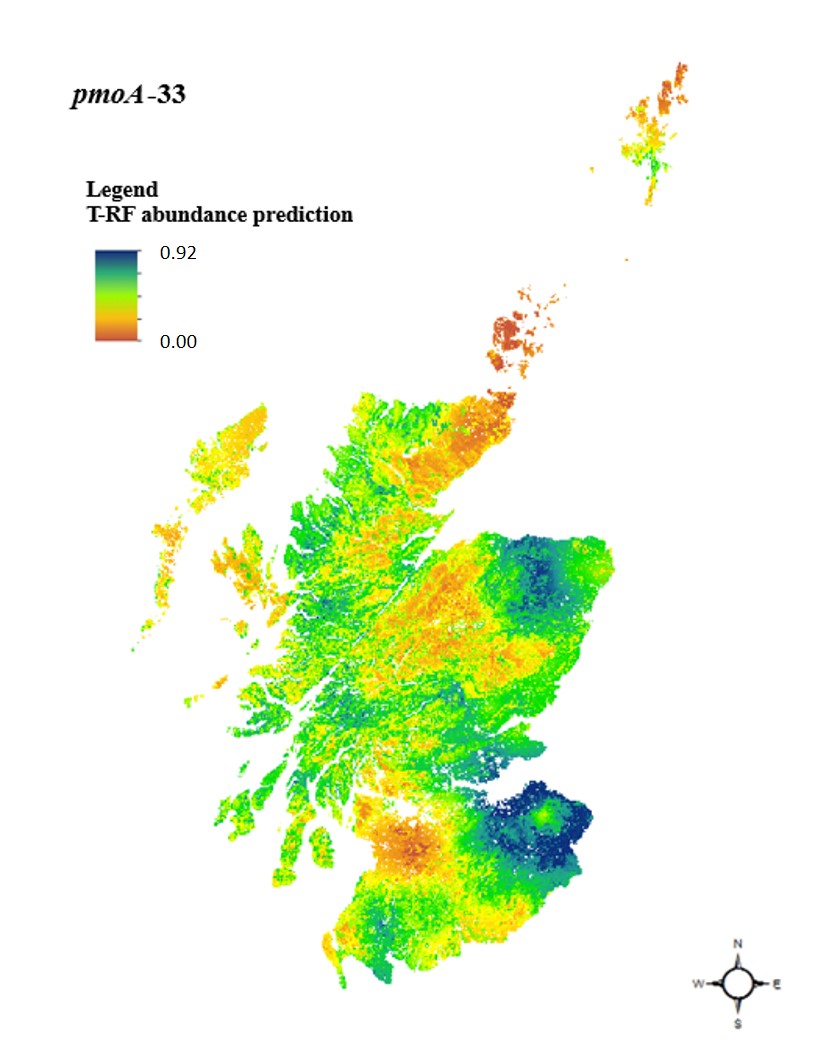
- Nazaries et al. (2018) — Methanotroph geographical distribution: a national survey
Greenhouse Gas Emissions Under Climate Stress
In parallel, a series of collaborative studies examined how GHG fluxes change under warming and reduced rainfall in dryland forests. The Martins et al. series (2015, 2016, 2017) used field manipulations in Australia and the USA to quantify CO₂, CH₄, and N₂O responses to drought — work that directly informed the interactive GHG estimation tools developed later as a data consultant.
Carbon Priming and the EucFACE Experiment
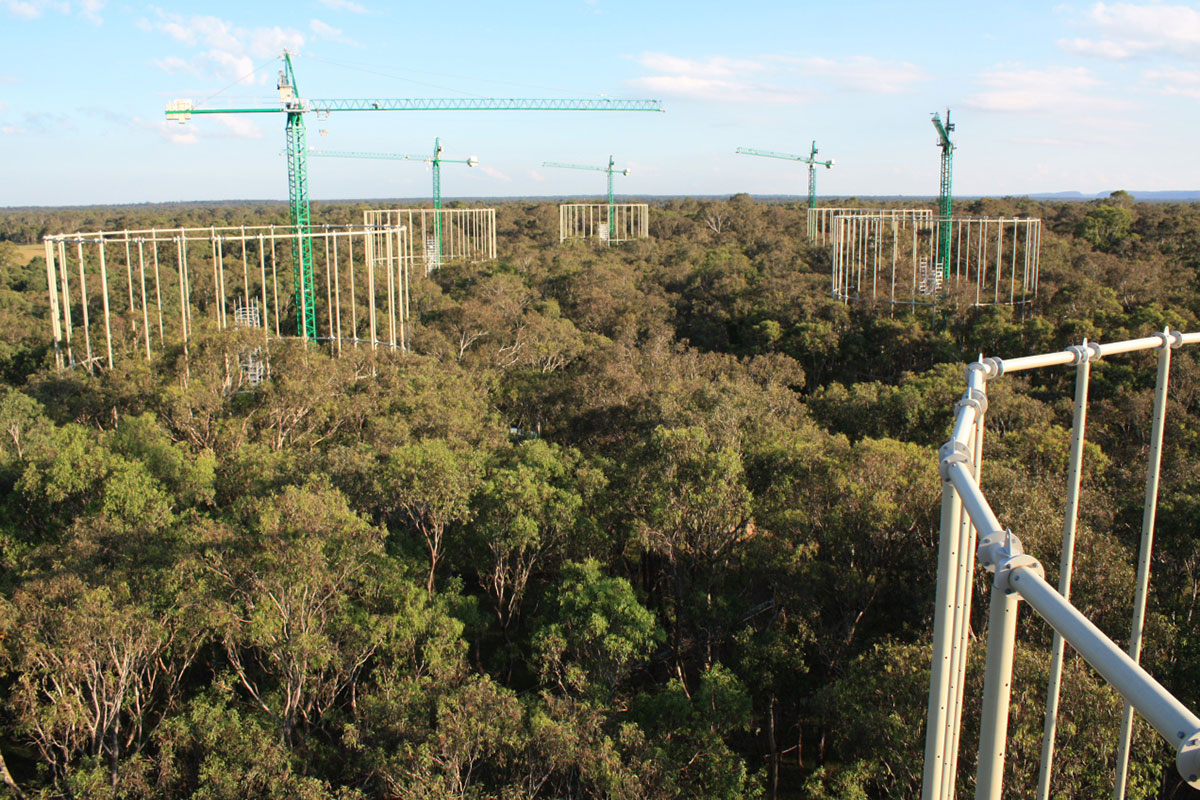
At the EucFACE site — a Free Air CO₂ Enrichment experiment in a mature eucalyptus woodland west of Sydney — we investigated how elevated atmospheric CO₂ alters the fate of carbon in soil. The Fang et al. (2018, 2019) papers explored microbial mechanisms of carbon priming in biochar-amended soils, and Jiang et al. (2020) traced the broader fate of carbon inputs across the ecosystem.
Bioremediation: Pesticide-Degrading Bacteria
One thread of the research diverged into applied microbiology: the characterisation of bacteria capable of degrading chlorpyrifos, a widely used organophosphate pesticide. Rayu et al. (2017), published in Frontiers in Microbiology, isolated and described three novel degrading strains — Pseudomonas sp. 4H1-M3, Xanthomonas sp. 4R3-M1, and Rhizobium sp. 4H1-M1 — from sugarcane farm soils in Australia.
Supervising the Next Generation
Science is as much about mentorship as it is about discovery. Two PhD students I had the privilege of supervising went on to produce excellent independent research:
- Smriti Rayu — whose doctoral work on microbial bioremediation of organophosphate compounds in agricultural soils led directly to the Rayu et al. (2017) publication in Frontiers in Microbiology
- Catarina S. Martins — whose field-based research on greenhouse gas emissions under drought and warming in dryland forests produced the Martins et al. series (2015–2017)
Institutions and Collaborators
The research was embedded in strong institutional networks. The Hawkesbury Institute for the Environment provided the scientific home during the most productive years. Applied work was funded and supported by the Grains Research and Development Corporation (GRDC), whose interest lay in soil health and sustainable agricultural practice.
Recurring scientific collaborators included Brajesh K. Singh (PhD supervisor and senior co-author), Uffe N. Nielsen, and the broader microbial ecology community centred around the ISME (International Society for Microbial Ecology) conferences — where several of our group’s findings were first presented as posters in 2010, 2012, and 2014.
The Pivot to Data
By the late 2010s, something had shifted. The datasets generated by environmental research were growing faster than the tools available to interpret them. More time was being spent on data pipelines, statistical modelling, and visualisation than at the bench. That observation crystallised into a deliberate career decision.
The skills that make for rigorous science — designing experiments, questioning assumptions, communicating uncertainty — transfer cleanly to data work. What changed was the domain: from soil carbon stocks to business KPIs, from gas flux time series to ETL pipelines, from Excel and lab notebooks to Python, SQL, and Tableau.
The archive of 19 publications and two doctoral theses remains. So does the instinct to ask: what does the data actually say?
For a full list of publications, see the Scientific Publications section.